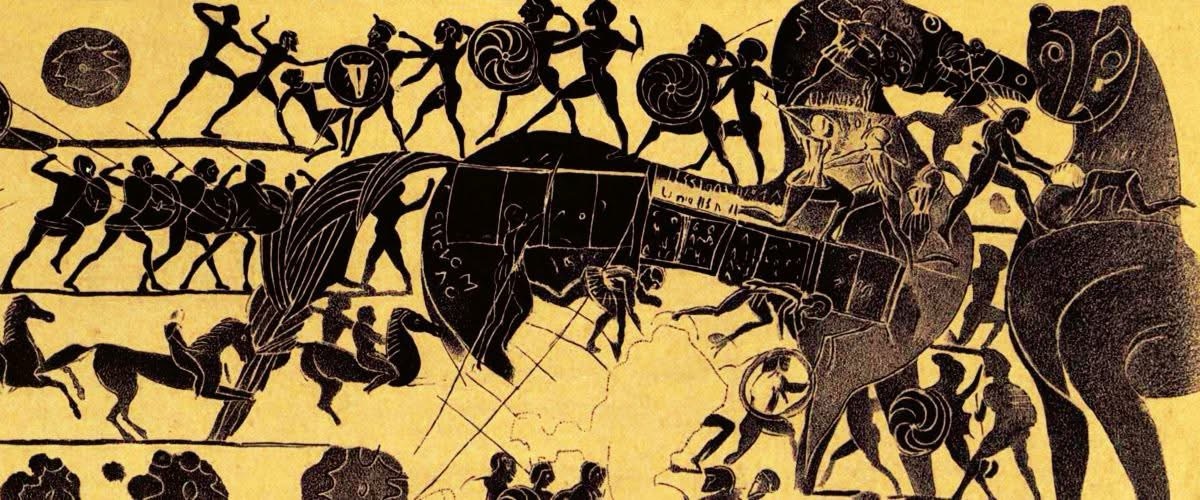
They say a face launched a thousand ships.
For Helen of Troy, kings crossed the sea, armies bled,
and a city was reduced to ashes—
all for a bride who became the occasion of adultery and war.
But if pagans would risk everything for a defiled bride,
what should we—
servants of the living God—
be willing to endure
for the precious Bride of Christ?
Continue reading below…
By Eric Joseph Gersbacher
A servant of God and of the Lord Jesus Christ
Word of Life School of Christ
Test everything by the Word of God. Hold fast what is good.
Psalm 36:9; 1 Thessalonians 5:21; 1 John 4:1, 6
She is not a fading beauty to be admired.
She is the Church—the redeemed Bride of Christ—
purchased not with Trojan gold,
but with the precious blood of the Son of God,
“the church of God, which He obtained with His own blood”
(Acts 20:28).
And she is under assault.
Some may ask, “Why are you attacking the Church?”
But I am not attacking the Church.
I am not condemning her.
The watchman was commanded to sound the trumpet and give warning.
Likewise, gospel preachers must declare the whole counsel of God, watch for wolves, reprove, rebuke, and exhort with complete patience and teaching
(Acts 20:26–31; 2 Timothy 4:2).
This is not an attack upon the Church—
it is a loving alert for the protection of Christ’s Bride.
So beware. Examine these things.
Test everything against the Word of God.
Beware of twisted doctrine.
“Even if an angel from heaven should preach a gospel other than the one we preached, let him be under God’s curse!” (Galatians 1:8).
So we contend for the faith once for all delivered to the saints (Jude 3).
We fight the good fight of faith (1 Timothy 6:12)—
not with swords, but with sound teaching,
even when ears itch for fables (2 Timothy 4:2–4).
Beware of compromised holiness.
Christ gave Himself up for her “to make her holy… without spot or wrinkle… holy and blameless” (Ephesians 5:25–27). Paul cried: “I am jealous for you with a godly jealousy…
to present you as a pure virgin to Christ” (2 Corinthians 11:2). We pursue holiness,
for without holiness no one will see the Lord (Hebrews 12:14).
Beware of forgetting your identity.
Do not excuse compromise by saying, “I’m just a sinner,”
or, “I’m only human.”
The New Testament repeatedly reminds believers
who they are in Christ.
Paul writes “to the saints”
(Romans 1:7; 1 Corinthians 1:2; Ephesians 1:1; Philippians 1:1).
We are called to “walk in a manner worthy of the calling
to which you have been called” (Ephesians 4:1),
to “walk by the Spirit” (Galatians 5:16),
and to “walk in the light” (1 John 1:7).
John writes: “My little children, I am writing these things to you so that you may not sin. But if anyone does sin,
we have an advocate with the Father,
Jesus Christ the righteous” (1 John 2:1).
The goal is not to excuse sin but to flee from it.
Christ is our Advocate when we sin and return to Him in confession—
not our permission slip to continue in disobedience.
Grace teaches us “to renounce ungodliness and worldly passions” and to live self-controlled, upright,
and godly lives (Titus 2:11–12).
Beware of lowering God’s standard to match
human weakness.
Christ did not call us merely to bear the name “Christian”;
He called us to be holy, for He is holy (1 Peter 1:15–16).
Beware of growing cold in love.
“You have abandoned the love you had at first”
(Revelation 2:4–5).
Do not fight for a creed alone—
fight for a Person.
If you have all knowledge and all faith but have not love,
you are nothing (1 Corinthians 13:1–3).
Love one another as Christ loved us (John 13:34–35).
Beware of corrupted leadership.
Even from among the flock, savage wolves arise,
speaking twisted things to draw away disciples after themselves (Acts 20:29–30).
The pulpit can become a stage.
Shepherds can become hirelings who flee
when the wolf comes (John 10:12–13).
Beware of an infatuation with titles and human honor.
Jesus said: “You are not to be called Rabbi…
Call no man your father on earth… Neither be called instructors, for you have one Teacher, the Christ”
(Matthew 23:8–10).
Yet religious titles continue to multiply,
as though academic credentials could confer spiritual authority.
But no title can speak for God.
Only Scripture carries the Name of the Lord.
Titles—academic or otherwise—
often function for believers as the lab coats did in the Milgram experiment—
people complied because of the perceived authority of the one wearing the coat,
not because they had examined whether what they were being told was right.
Paul—who wrote much of the New Testament—
called himself simply “a servant of Christ Jesus” (Romans 1:1) and “the least of the apostles” (1 Corinthians 15:9).
Truth does not become truth because a credential stands behind it.
Truth must be tested by the Word of God.
A title may describe a man’s training,
but it does not make one necessarily wiser,
only that they have completed a course of study to the satisfaction of the program.
It cannot establish his doctrine.
Every disciple is responsible to test what is taught.
The Bereans examined even Paul’s teaching daily to see whether these things were so (Acts 17:11).
John commands: “Do not believe every spirit,
but test the spirits…” (1 John 4:1),
and, “Whoever knows God listens to us…
By this we know the Spirit of truth and the spirit of error”
(1 John 4:6).
The authority is not the man.
The authority is the word of Christ delivered
through His apostles.
Beware of confused offices.
Pastors and elders are commanded to shepherd the flock and be examples
(1 Peter 5:2–3),
not to rule as lords over God’s heritage.
Meanwhile the evangelist has often been reduced to an occasional speaker rather than the herald of the King.
Paul charged Timothy:
“Do the work of an evangelist;
fulfill your ministry” (2 Timothy 4:5).
The elder is to hold firmly to the faithful word (Titus 1:9).
The evangelist is commanded to preach the Word (2 Timothy 4:2).
Both are gifts Christ gave His Church (Ephesians 4:11–12).
When Christ’s pattern is replaced with human systems, the Bride suffers.
Beware of man-made requirements burdening God’s callings.
The qualifications God gave for elders have often been imposed upon evangelists and preachers where Scripture does not impose them.
Paul was unmarried (1 Corinthians 7:7–8).
Timothy is never described as married while being charged to do the work of an evangelist (2 Timothy 4:5).
Titus was left to appoint elders (Titus 1:5),
yet Scripture never requires him to possess every qualification he was to examine in others.
Jeremiah was commanded not to marry (Jeremiah 16:1–2). Hosea was commanded to marry a prostitute (Hosea 1:2).
Ezekiel’s wife was taken from him as part of God’s prophetic message (Ezekiel 24:15–18).
God calls His servants according to His own wisdom and purpose.
As they respond to the gospel (2 Thessalonians 2:14),
they are to demonstrate the character and conduct required of all faithful servants,
such as those found in 1 Timothy 4–6—
not the qualifications for overseers given
in 1 Timothy 3 or Titus 1.
The disciple’s responsibility is to follow Christ and His Word by faith—
not to submit to human traditions that add requirements where God has not.
Congregations that manufacture additional requirements for those who preach place themselves in peril by adding to God’s Word and binding burdens that God has not bound.
(Colossians 2:8; Mark 7:6–9;
Deuteronomy 4:2;
Revelation 22:18–19;
Matthew 23:4; Galatians 5:1).
Beware of silent shepherds.
Many fear losing members more than losing souls. Instead of preaching the Word in season and out of season
(2 Timothy 4:2), they become men-pleasers rather than servants of Christ (Galatians 1:10).
They avoid difficult truths.
They tolerate error.
They refuse to expose darkness
(Ephesians 5:11).
They cry, “Peace, peace,”
when there is no peace
(Jeremiah 6:14).
They neglect the whole counsel of God
(Acts 20:27).
The Bride deserves better.
The Chief Shepherd deserves better.
Beware of tradition overriding Scripture.
The issue is not tradition. The issue is Christ.
The scribes and Pharisees possessed the Scriptures,
yet through their traditions they nullified the Word of God (Matthew 15:3–9).
Jesus said:
“You search the Scriptures because you think that in them you have eternal life;
and it is they that bear witness about Me,
yet you refuse to come to Me that you may have life”
(John 5:39–40).
The lesson is plain: possessing Scripture is not enough if we allow human tradition to override it.
The standard is not the church fathers.
The standard is not even the Restoration Movement itself.
We do not restore the Restoration Movement;
we seek the restoration of obedience to Christ’s New Testament, the apostles’ doctrine (John 17:17-21; Acts 2:42).
Every restoration effort, leader, slogan, conclusion,
and inherited practice must itself be tested
by the teaching of Christ and His apostles (1 John 4:1, 6).
The standard is not denominational theology.
The standard is not party loyalties.
The standard is not the brotherhood.
The standard is not a Bible school of any kind.
The standard is not any teacher who came after the apostles.
Every generation must return to the same foundation—
the teaching of Christ and His apostles.
Jesus declared: “The one who rejects Me and does not receive My words has a judge; the word that I have spoken will judge him on the last day” (John 12:48).
David testified: “Through Your precepts I get understanding; therefore I hate every false way” (Psalm 119:104).
“Your word is a lamp to my feet and a light to my path”
(Psalm 119:105).
And again: “For with You is the fountain of life;
in Your light do we see light” (Psalm 36:9).
Yet the Lord lamented through Jeremiah: “They have forsaken Me,
the fountain of living waters,
and hewed out cisterns for themselves,
broken cisterns that can hold no water” (Jeremiah 2:13).
Every time we elevate human tradition above the teaching of Christ,
we exchange the fountain of living water
for broken cisterns.
John commands: “Beloved, do not believe every spirit,
but test the spirits to see whether they are from God…”
(1 John 4:1).
And again: “We are from God.
Whoever knows God listens to us… By this we know the Spirit of truth and the spirit of error” (1 John 4:6).
He further warns: “Everyone who goes on ahead and does not abide in the teaching of Christ,
does not have God” (2 John 9).
Paul likewise commands: “And whatever you do, in word or deed, do everything in the name of the Lord Jesus…” (Colossians 3:17).
And again: “Learn by us not to go beyond what is written”
(1 Corinthians 4:6).
Therefore, every doctrine, every practice, every title,
every office, every tradition, every theological system,
every movement, every confession, every creed,
every appeal to the church fathers,
every appeal to Restoration history,
every appeal to the brotherhood,
every appeal to any Bible school,
every appeal to denominational or partisan theology
must be tested by the teaching of Christ and His apostles,
and when found is disagreement, discarded for the teaching of Christ and His apostles (1 John 4:1, 6).
The authority is not antiquity.
The authority is not popularity.
The authority is not scholarship.
The authority is Jesus Christ speaking through the Scriptures. As the Bereans demonstrated,
even Paul’s preaching was examined daily by the Scriptures, and Luke called them noble for doing so (Acts 17:11).
Therefore, every teacher since the apostles must likewise be tested—not by tradition, reputation, or title,
but by the Word of God.
This is no worldly pursuit.
This is a spiritual war.
Do not run for a crown that fades,
but for one that lasts forever
(1 Corinthians 9:25–27).
Our light affliction is achieving for us an eternal weight of glory beyond all comparison (2 Corinthians 4:17–18).
Fix your eyes not on what is seen,
but on what is unseen—
on the Holy City, the New Jerusalem,
prepared as a Bride adorned for her Husband
(Revelation 21:2).
So put on the full armor of God
(Ephesians 6:13–14).
Endure hardship as a good soldier of Christ Jesus—
do not get entangled in civilian affairs
(2 Timothy 2:3–4).
Be watchful. Stand firm in the faith.
Act like men.
Be strong.
And let all that you do be done in love
(1 Corinthians 16:13–14).
Helen inspired kings and armies to cross the sea.
Christ came from heaven and gave Himself for His Bride.
If kings would die for Helen,
will you shrink back from suffering for the Bride of Christ?
If the world will fight for a fading glory,
will you not contend for the bride of our eternal King?
To God be the glory, forever and ever. Amen.
 Word of Life School of Christ